Julia Langley Faculty Director Georgetown Lombardi Arts and Humanities
Julia Langley, Faculty Manager
Georgetown Lombardi Arts and Humanities Programme Managing director Joins Medical Faculty
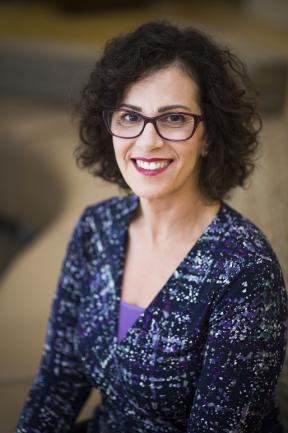
August 17, 2017 – Since she started serving as the director of the Arts and Humanities Program at Georgetown Lombardi Comprehensive Cancer Center in 2014, Julia Langley has created therapeutic experiences for patients, caregivers and hospital staff using professional artists, musicians and dancers.
Recently, Langley received another title – instructor at Georgetown University Schoolhouse of Medicine section of oncology in the medical didactics track. While her new position may make her the first fine art historian appointed to the faculty at a major medical center, Langley is focused on using the opportunity to railroad train the adjacent generation of medical professionals to approach patient intendance from a dissimilar perspective.
For instance, 1 of the things Langley has done is develop a class in collaboration with the National Gallery of Art that helps hereafter health intendance providers become more than skilled at observation, advice and recognizing explicit biases. For one exercise from the form, Langley asks students to describe what'southward happening in a large painting full of detail and action, challenging them to use precise language without making assumptions.
"Our job is to teach people how to meet," she said.
'Information technology Was The Job I Was Born to Do'
Langley'south teaching, also as her personal and professional person experiences, make her uniquely qualified for her position at Georgetown Lombardi. However, working at a cancer center was not part of her original career programme.
An art historian past training with a graduate degree in art history from UCLA, Langley studied dance for 15 years and music for six years. She likewise worked at the University of California – San Diego every bit banana manager of the Stuart Collection of outdoor sculpture and managing director of development for the vice chancellor of health sciences. In that position, Langley developed a magazine that profiled the enquiry and clinical programs at the university's medical center. She enjoyed interviewing doctors most their enquiry but writing about cancer felt different. "I retrieve going into the cancer middle and thinking, I hope I never have to come back here," Langley said. "It was and so sad."
Two years later, afterwards moving to Washington, DC, Langley was diagnosed with breast cancer and received treatment at Georgetown Lombardi for six years. When she was finally declared cancer-free and ready to return to work, Langley learned of an opening in the Arts and Humanities Program.
"I thought, I never want to get back to Lombardi again," she said. However, a friend insisted she check it out, so Langley arranged a visit with the retiring director, Nancy Morgan, who gave her a bout. While watching a violinist collaborate with patients, "information technology was like I was hit in the head with a hammer," Langley said. "I thought, of course, this is where I am supposed to exist. I admittedly feel it was the task I was born to do."
Developing Effective Programs
In Langley's course at the National Gallery, medical students critically analyze original works of fine art to build skills that support visual literacy, communication and empathy. Through interactive exercises in the galleries and grouping reflection, the students think through how they can apply what they've learned to their piece of work, enhancing relationships with patients, other members of medical teams, caregivers and colleagues.
Langley is also working with collaborators to evaluate unlike ways of using the arts to enhance patient care to come across which are the most effective. They are currently studying whether playing music in the NICU helps babies grow and thrive, the utilize of trip the light fantastic to care for people with move disorders and how art can prevent burnout in doctors and staff.
Doctors are increasingly looking to assist patients using not-pharmacogenic techniques, including mindfulness and stress reduction, Langley said. "The therapies offered by our professional artists, which include music, expressive writing, handwork and guided imagery, give patients and staff effective coping techniques they tin use whenever they need them," she said.
Creating a Welcoming Habitation for Patients and Staff
When Langley isn't teaching, doing research or leading Arts and Humanities Plan activities, she can be establish in her function in the heart of the cancer heart. Choosing an part was one of the commencement things she did when she started working at Lombardi, and Langley later realized that decision was fortuitous.
The space previously functioned every bit the Nina Hyde Resources Center, a large room with brochures and other materials made obsolete by websites. Langley transformed the room into a welcoming space filled with sofas, chairs and art, as well every bit desks for her and her assistant.
"Now, people walk through my office all day long," Langley said. "We're like this little key surface area of happy people in the middle of this actually hard place." She and her banana reply questions and mostly just try to be present for people, she said, something that the health care system has left nigh staff unable to do due to lack of fourth dimension.
"The matter about affliction is that information technology's absurd," Langley said. "You come into a wellness care surround and you experience everything is taken from you – your identity, your future." To counter that, "nosotros just try to love and back up people all day long."
Kathleen O'Neil
GUMC Communications
Source: https://lombardi.georgetown.edu/artsandhumanities/director/
0 Response to "Julia Langley Faculty Director Georgetown Lombardi Arts and Humanities"
Post a Comment